

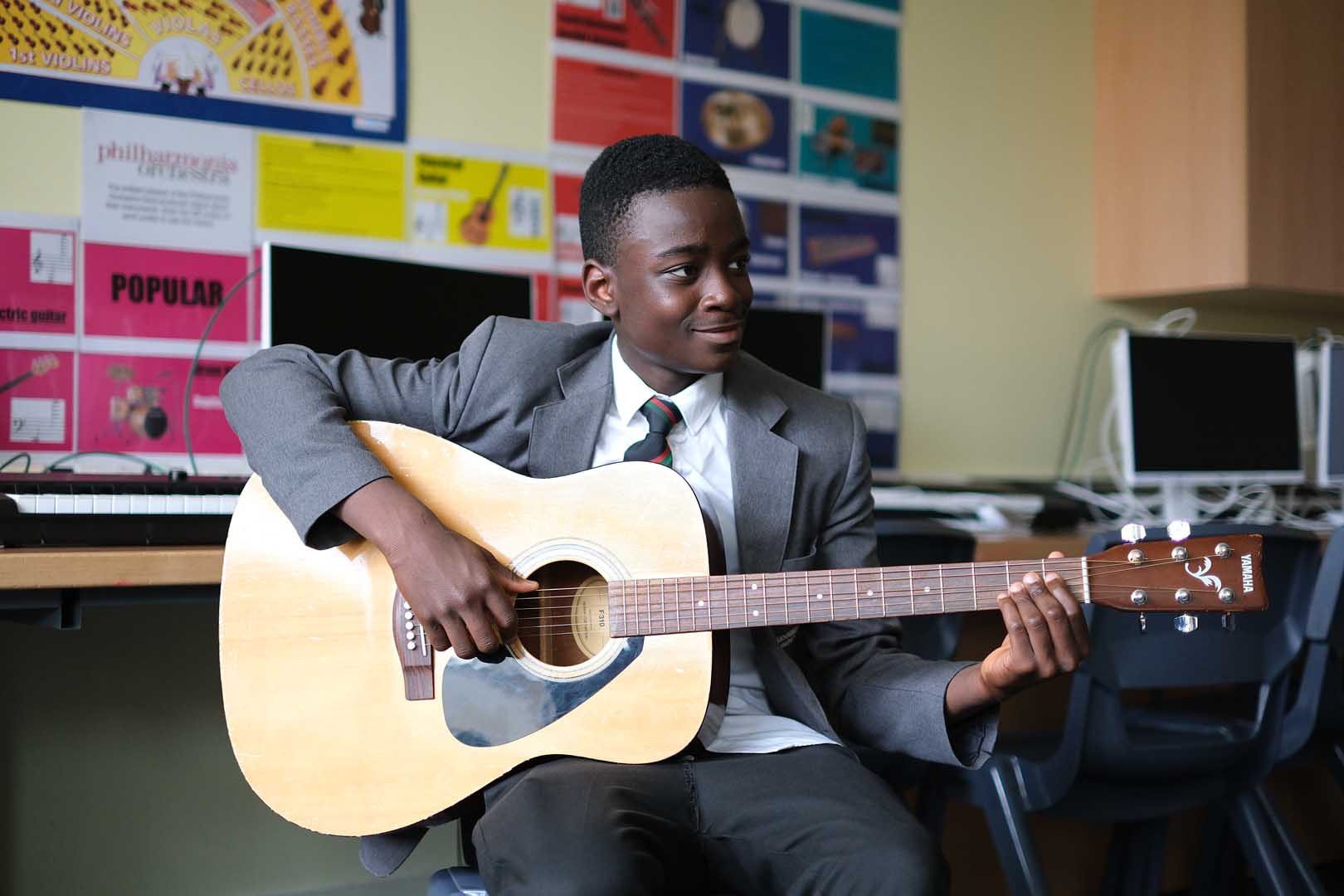
Music
Our music department is committed to embracing and nurturing the academic and performance abilities of any pupil who is interested in music.performing arts overarching vision
As a subject the Performing Arts reach out and branch into the many facets of our day to day lives. They inspire conversations and create friendships through the discussions we have about what we watch on TV, listen to on the radio or see online and in theatres. The performing arts teach us to be creative, reflective and resourceful in what we do, they enable us to speak with confidence in front of others as well as develop our emotional intelligence and empathy.
Arts and culture help tackle social injustice - theatres, museums, galleries and libraries are the beating heart of our towns and cities. Not only do they bring prosperity, they bring communities together and make life worth living. - Arts Council for England
Through the Performing Arts our young people within all LET schools are able to express a range of emotions within the safety of the classroom or studio. They are able to develop holistically and gain insights and experience into different ways of life. They can push boundaries and move beyond the safety of the familiar and conventional. To put it simply the arts matter.
“Music is the universal language of mankind.” – Henry Wadsworth Longfellow
“Music can name the unnameable and communicate the unknowable.” – Leonard Bernstein
the importance of music at judgemeadow
Much has been made of the diverse and important skills that music brings to students: co-operation, collaboration, group work, increased ability to manage cognitive load, discipline and creativity. However, the reason that we at Judgemeadow teach Music first and foremost is because Music is wonderful, and we consider that education in all subjects should encourage wonder in the world around us. We are aware that Music as a curriculum subject offers once-in-a-lifetime opportunities on a daily basis, and we aim to enrich students’ experience of the world in every way possible.
music curriculum
The curriculum is built around the three core principles of Music: performance, composition and listening/appraising, which is mirrored in the GCSE curriculum. When introducing musical concepts, we believe that students should have an opportunity to hear and do, and that all concepts should be experienced sonically by students. We support this holistic and integrated approach with the use of knowledge organisers in multiple languages to allow all learners to access the curriculum. Students develop skills in a variety of disciplines including: vocals, keyboards, ukulele, drumming, band work and Bandlab technology. They exercise creativity through composition and improvisation and all this is underpinned by regular teaching surrounding hearing and identifying the musical elements.
intended outcome
- Confident students who are able to enjoy a lifetime connection and appreciation of the Performing Arts disciplines.
- Students who show confidence in social skills and are able to engage positively in collaboration alongside self-reliance.
- Creative thinkers who are able to independently adapt, problem solve and offer solutions.
- Resilient students who are able to face challenges within and outside the Performing Arts.
- Reflective students who are analytical and able to evaluate their own and others performances and written work.
- Metacognitive learners who demonstrate self-motivation and self-regulation.
- Motivated and determined students who are fascinated with the world around them and how the arts contribute to their everyday lives.
timetabling
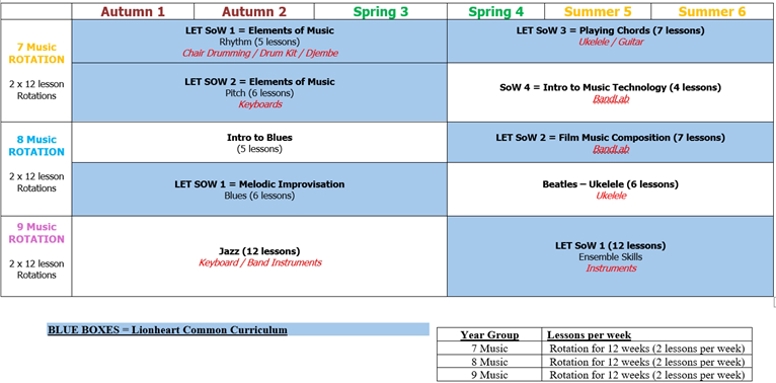
- Year 7: 24 lessons per year on rotation. Split into 4 units of work.
- Year 8: 24 lessons per year on rotation. Split into 4 units of work.
- Year 9: 24 lessons per year on rotation. Split into 2 units of work.
key stage 3 curriculum
The key stage 3 curriculum aims to lay a foundation of core musical knowledge and develop a series of practical and creative skills which will allow students to develop their own interests and passion for the subject. The musical elements (sonority, pitch, rhythm, texture, tempo, dynamics and structure) are repeatedly revisited in retrieval practice exercise and elaborated upon through the curriculum. All units of work fully embed the Learning Scientist principles: Retrieval Practice, Spaced Practice, Elaboration, Interleaving and Dual Coding.
Assessment model for KS3 data snapshots: Final grade is a combination of practical and listening assessments.
| attainment | year 7 | year 8 | Year 9 |
|---|---|---|---|
| Beginner | 7B | 8B | 9B |
| Beginner + | 7B+ | 8B+ | 9B+ |
| Working Towards | 7W | 8W | 9W |
| Working Towards + | 7W+ | 8W+ | 9W+ |
| Secure | 7S | 8S | 9S |
| Secure + | 7S+ | 8S+ | 9S+ |
curriculum overview
EXTRACURRICULAR OPPORTUNITIES
We offer a wide range of musical opportunities including but not limited to: vocal group, peripatetic instrumental lessons, keyboard club, rock/pop club, music competitions, karaoke club, creating music videos, workshops and watching live performance. The music department is open during the school day for independent practice and students are encouraged to cultivate their own musical interests.
“The arts are essential to any complete national life. The state owes it to itself to sustain and encourage them…. Ill fares the race which fails to salute the arts with the reverence and delight, which are their due” – Winston Churchill